What the public records show about Valar Atomics in Castle Country
The strongest findings so far, each checked against its source. Every line links to the documents, and each Claims vs Record entry names the record that would settle it.
What you can do about it →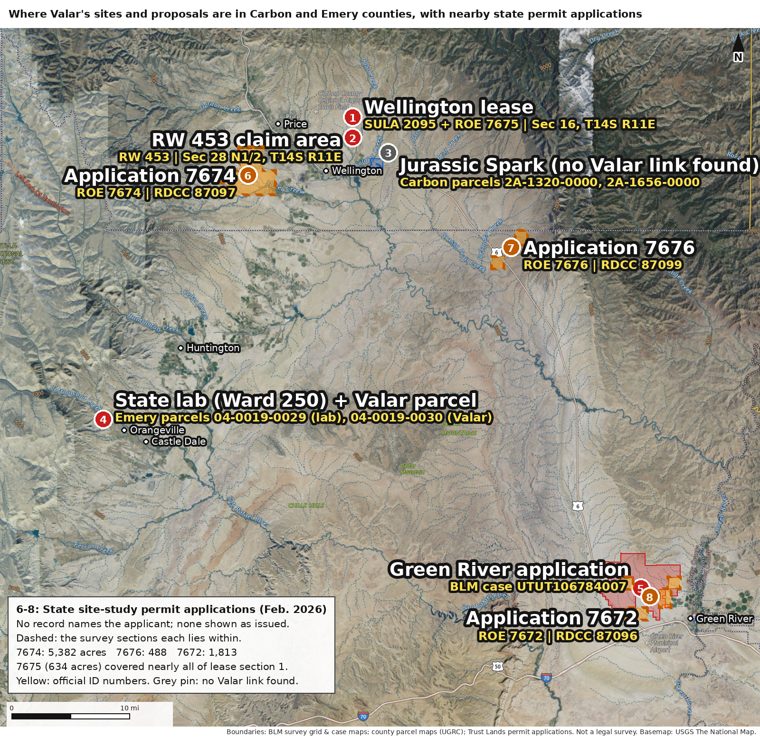 Every site, to scale: tap to see where each project is going and how big it isWellington lease, the RW 453 claim, the Orangeville lab, Green River, and more →
Valar said holding spent fuel from its planned Ward One reactor for five minutes is like getting a CT scan.
“holding the spent fuel from this system for five minutes” gives “the equivalent radiation exposure to receiving a CAT scan”Valar Atomics, 'Valar Atomics is Suing the NRC', April 2025
- The sentence is about Ward One, a planned 100-kilowatt-thermal reactor whose planned lifetime was 'less than a month'. No calculation behind it was found published on Valar's site.
- For scale: a CT scan is about 1 to 10 millisieverts (FDA). To match that in five minutes, the fuel would give only 12 to 120 millisieverts an hour. Valar's post gives no amount of fuel, cooling time, distance or shielding.
- Our math (open it below): one day after it stops, five minutes with all of Ward One's used fuel gives your body 8 to 33 times the top of a CT scan's range, not one scan. It only gets down to one scan for a tiny piece or after months of cooling, and Valar has not shown its own math.
- For Ward 250, a larger reactor, Valar's own safety paper treats radiation shielding as a safety function, and DOE's review has the used fuel leave the site in dry storage casks.
- In Valar's favour: low power and a short run leave far less radioactive material. For the larger Ward 250, DOE's review puts the fission-product inventory 'orders of magnitude below' a commercial power reactor's.
- The sentence is still on Valar's website, word for word, with no correction found as of Sept 29, 2026. Between March and July 2026 the page was tagged asking search engines not to list it; the record does not show who added that or why.
Work it out: our own calculation, step by step It was worked out twice, independently, and a third check reconciled the two. Every input Valar left out is shown as a range, set in Valar's favour.
What the document says
Valar's April 2025 post describes Ward One as a 100 kWt high-temperature gas reactor using TRISO fuel, with a planned operational lifetime of less than a month, and says: "Our analysis indicates that holding the spent fuel from this system for five minutes" gives the same radiation exposure as a CAT (CT) scan. The post does not say how much fuel is held, how long the reactor ran, how long the fuel cooled, how far it is from the body, or which dose is meant, and the analysis it cites has not been published. The text is the same in the live page (29 September 2026) and in Internet Archive captures of 23 March and 22 July 2026.
Given
- P₀ = 100 kW thermal (Valar post, Ward One paragraph)
- Fuel = TRISO fuel in a high-temperature gas reactor; fuel mass, enrichment and element type not stated (Valar post, Ward One paragraph)
- T = run of 1 to 30 full-power days (the post gives only a planned operating lifetime of less than a month); break-even run length also solved (Valar post; the range is an assumption)
- t_hold = 5 minutes = 300 s (Valar post)
- f = share of the core's fission products held: the whole core (the literal reading), 1/76 of the core (one of Ward 250's 76 fuel elements, as a stand-in), one 6 cm pebble holding 7 g of uranium (1/35,700 of a 250 kg core), and the break-even share (assumption; Ward 250 NSDA Table 6, p. 52; INL/EXT-20-60236 Table 2)
- t = cooling time after shutdown: 1 day to 1 year shown, break-even solved; less than 1 day not modelled (it would give more) (assumption (the post states none))
- M = 250 kg of uranium in the core (stand-in; a larger core spreads the fission products more thinly per gram) (Ward 250 NSDA Table 6, p. 52 (a different Valar reactor of the same 100 kW))
- E_f = 200 MeV per fission, so 3.12 × 10¹⁰ fissions per watt-second (Lamarsh & Baratta, Introduction to Nuclear Engineering, ch. 3)
- y, T½, gamma lines = U-235 thermal cumulative fission yields (e.g. Zr-95 6.50%, Ba-140 6.21%, Te-132 4.30%, I-133 6.70%); half-lives and principal gamma lines of 43 fission products (ENDF/B-VII.1 and JEFF-3.1 yields; ENSDF decay data via NuDat 3)
- μ/ρ, μ_en/ρ = graphite and uranium attenuation; air and soft-tissue energy absorption (tissue = 0.990 × water, ICRU-44) (NIST, Hubbell & Seltzer (NISTIR 5632))
- E/K_a = 1.00 to 1.43 Sv of effective dose per Gy of air kerma, front-on (AP) exposure (ICRP Publication 74, Table A.17)
- Pebble = 6 cm ball: 2.5 cm fuelled zone inside a 0.5 cm fuel-free shell; matrix graphite 1.70 g/cm³ (1.75 used); 7 g of uranium (the HTR-PM value; INL's benchmark pebble holds 9 g) (INL/EXT-20-60236 Rev. 1, Tables 2-3)
- d = body reference point 50 cm from the near surface of what is held (30 cm as a sensitivity) (assumption)
- CT = 1 to 10 mSv effective dose for typical diagnostic CT; FDA table values from 2 mSv (head) to 16 mSv (coronary CT angiogram) (FDA, What are the Radiation Risks from CT?, text and Table 1)
Working
- F = 1.0 × 10⁵ W ÷ (200 MeV × 1.602 × 10⁻¹³ J/MeV) = 3.12 × 10¹⁵ fissions/s 30 full-power days: 0.1 MW × 30 d = 3.00 MWd = 8.09 × 10²¹ fissions; 1 full-power day: 0.10 MWdThe radioactive fragments in spent fuel depend on how many uranium atoms were split, that is on power × running time, not on how much uranium was loaded. 200 MeV per fission is the textbook value; 193 MeV would raise every dose below by about 4%. The post's 'less than a month' is taken as a run of 1 to 30 full-power days.
- A_i(T, t) = y_i × F × (1 − e^(−λ_i T)) × e^(−λ_i t) daughters (La-140 from Ba-140, Nb-95 from Zr-95, I-132 from Te-132 and others) by the two-member Bateman equationsActivity of each gamma-emitting fission product after running for T and cooling for t, from U-235 fission yields and half-lives. Gases and iodine are taken to stay inside the intact fuel particles.
- S_γ = Σ_i A_i × (gamma energy per decay)_i whole core, 30-day run: 164 W at 1 day of cooling, 25 W at 30 days, 0.49 W at 1 yearGamma-ray power given off by the fission products. Cross-check: half of the Way-Wigner decay-heat formula, 0.0622 × [t^−0.2 − (t + T)^−0.2] × 100 kW (t and T in seconds), gives 159 W at 1 day and 21 W at 30 days; gamma rays carry roughly half of fission-product decay heat. At 1 day lanthanum-140 (34%) and iodine-132 (21%) give most of it; at 30 days, lanthanum-140, zirconium-95 and niobium-95.
- One CT in five minutes: (1 to 10 mSv) ÷ (5/60 h) = 12 to 120 mSv/hFDA gives typical effective doses of 1 to 10 mSv for diagnostic CT. The claim is counted as met at any five-minute dose up to 10 mSv, the top of that range.
- Piece held = a solid ball of fuel: R = [3 f M ÷ (4π ρ_HM)]^(1/3), ρ_HM = 7 g ÷ 113.1 cm³ = 0.0619 g/cm³, M = 250 kg whole core R = 98.8 cm; 1/76 of the core R = 23.3 cm; one pebble: 2.5 cm fuelled zone inside a 0.5 cm graphite shell μ = 1.75 g/cm³ × (μ/ρ)_graphite + ρ_HM × (μ/ρ)_uranium = 0.139 per cm at 0.7 MeVf is the share of the core's fission products held. Ward One's fuel mass and form are not public, so Valar's Ward 250 figures (250 kg of uranium, 76 fuel elements; a different reactor) and a standard 6 cm pebble stand in. A ball of fuel with no gaps, at a graphite density above INL's 1.70 g/cm³, absorbs more of its own radiation than a real core would, which lowers every dose here.
- φ(d) = (S_v ÷ 2μ) ∫₀^(π/2) sin α × (R/d) × (cos β ÷ cos α) × e^(−μs) × (1 − e^(−2μR cos β)) dβ, sin α = (R/d) sin β, s = path through the pebble's fuel-free shell (zero for a uniform ball)The exact rate at which gamma energy leaves the ball without scattering and reaches a point at distance d from its centre (S_v is the gamma power per cm³). Checks: it reproduces the closed-form contact result, the point-source result far away, and an independent shell integral to six digits.
- Whole body: E = 300 s × Σ φ(R + 50 cm) × (μ_en/ρ)_air × (E/K_a)_AP Hand: H = 300 s × Σ φ(R) × (μ_en/ρ)_tissue, (μ_en/ρ)_tissue = 0.990 × (μ_en/ρ)_waterEffective dose, the quantity FDA uses for CT, is estimated from the air dose at a point 50 cm from the near surface of the fuel, converted with ICRP Publication 74's front-on factors (1.0 to 1.4 Sv per Gy). The hand dose is the dose to the skin where it touches the fuel. It is not an effective dose and is not compared with the CT figure.
- 30-day run, whole-body dose in five minutes: whole core: 334 mSv at 1 day of cooling, 54 mSv at 30 days, 0.99 mSv at 1 year 1/76 of the core: 64, 10.3 and 0.19 mSv one 7 g pebble: 0.77, 0.12 and 0.0024 mSvAgainst a 10 mSv CT, the whole core gives 33 times as much at 1 day and 5.4 times at 30 days; one pebble is below FDA's 1 to 10 mSv range. Hand on the fuel at 1 day: 1,379 mSv (core surface), 1,182 mSv (1/76) and 316 mSv (pebble). The whole core and the 1/76 piece (about 100 kg in this model) cannot be lifted; they are shown because the post says 'the spent fuel'.
- 1-day run, whole-body dose in five minutes: whole core: 75 mSv at 1 day of cooling, 3.0 mSv at 30 days; 1/76 of the core: 14.6 and 0.56 mSv; one pebble: 0.18 and 0.006 mSvThe low end of 'less than a month'. A shorter or lower-power run gives less (see the break-even run length below).
- Solve E(f) = 10 mSv for the share f held: 30-day run, 1 day of cooling: f = 1/1,589, about 157 g of uranium or 22 pebbles' worth in a 250 kg core (a ball 17 cm across) 30-day run, 30 days: f = 1/81 (3.1 kg); 1-day run, 1 day: f = 1/156 (1.6 kg) for a 1 mSv CT: 8.7 g, 85 g and 50 gHow small a piece makes five minutes equal one CT, as whole-body dose. Held 30 cm from the body instead of 50 cm, the 157 g falls to 48 g; against FDA's highest table value (16 mSv, coronary CT angiogram) it rises to 310 g.
- One pebble-sized piece: E = 10 mSv when it holds 1/2,759 of the core's fission products (30-day run, 1 day of cooling)So the single-pebble result needs a core of at least about 2,760 pebbles' worth of fuel (about 19 kg of uranium at 7 g each). A 250 kg core holds about 35,700. Ward One's core size is not public.
- Solve E(t) = 10 mSv for the cooling time t, and E(T) = 10 mSv for the run length TWhole core: 128 days of cooling after a 30-day run, 9.6 days after a 1-day run (365 and 62 days for a 1 mSv CT). 1/76 of the core: 31 days and 1.4 days. One day after shutdown, the whole core matches a 10 mSv CT only if the reactor ran about 2.1 full-power hours (8.7 kWd).
- Hand dose, one 7 g pebble, 30-day run, 1 day of cooling: 316 mSv in five minutes; for the 157 g break-even piece: 833 mSvSkin dose at the point of contact from gamma rays alone; beta particles would add more if bare fuel were touched. It is a different quantity from a CT's whole-body effective dose. For scale, the NRC's annual limit for the skin of a worker's hands is 500 mSv (10 CFR 20.1201). The pebble's hand dose falls to 10 mSv after about 129 days of cooling (30-day run) or 9 days (1-day run).
- Sensitivities, 30-day run, 1 day of cooling (factor on the whole-body dose): body 30 cm away instead of 50 cm: × 1.4 (core) to × 2.6 (pebble); scattered photons (buildup): × 1.35 to × 2.4 neptunium-239 from U-238 capture: × 1.04 to × 1.12; Ward 250's core volume instead of a solid ball: × 1.1 to × 1.2 9 g pebble (INL benchmark) instead of 7 g: × 1.27; only the 18 strongest emitters counted: × 0.89 to × 0.90Each choice the post leaves open was set to lower the dose; these factors show how far each could move the results. None of them moves a case across the 10 mSv line at 1 day of cooling.
Results: five minutes holding Ward One's spent fuel (mSv; a typical CT scan is 1 to 10 mSv whole-body)
| Reactor ran | Fuel cooled | All the spent fuel, whole-body | One fuel element (1/76), whole-body | One 6 cm pebble, whole-body | Skin of the hand touching that pebble |
|---|---|---|---|---|---|
| 30 days | 1 day | 334 | 64 | 0.77 | 316 |
| 30 days | 7 days | 163 | 31 | 0.36 | 147 |
| 30 days | 30 days | 54 | 10.3 | 0.12 | 49 |
| 30 days | 90 days | 14.9 | 2.9 | 0.036 | 15 |
| 30 days | 1 year | 0.99 | 0.19 | 0.0024 | 0.99 |
| 7 days | 1 day | 200 | 39 | 0.48 | 196 |
| 7 days | 30 days | 18 | 3.5 | 0.040 | 16.5 |
| 1 day | 1 day | 75 | 14.6 | 0.18 | 75 |
| 1 day | 7 days | 12.9 | 2.5 | 0.029 | 12 |
| 1 day | 30 days | 3.0 | 0.56 | 0.0064 | 2.7 |
Whole-body = effective dose, the quantity FDA gives for CT, at a point 50 cm from the near surface of the fuel. The last column is the skin dose where the hand touches the pebble: a different quantity, not comparable with a CT's whole-body figure. 'All the spent fuel' and 'one element' (about 100 kg in this model) could not be lifted by hand; they show what the post's words 'the spent fuel' mean taken literally. Scattered photons, beta particles and neptunium-239 are left out, so every figure is a lower estimate. Run length is in full-power days at 100 kW.
Result
With the post's 100 kWt and a run of 1 to 30 full-power days, five minutes with all of the reactor's spent fuel, 50 cm from the body, gives a whole-body effective dose of about 75 to 334 mSv one day after shutdown and 3 to 54 mSv after 30 days, against FDA's typical 1 to 10 mSv for a CT. It comes down to one 10 mSv CT only for a piece holding no more than about 1/1,600 of the core's fission products one day after a 30-day run (1/156 after a one-day run; 1/81 after 30 days of cooling), about 157 g of uranium or 22 pebbles' worth if the core held 250 kg; or, for the whole core, after about 10 to 128 days of cooling. One 7 g pebble gives about 0.8 mSv whole-body, below FDA's typical CT range, while the skin of the hand touching it receives about 316 mSv in the same five minutes, a different dose quantity. Scattered photons, beta particles and neptunium-239 are left out, so these are lower estimates.
Sources
- Valar Atomics is Suing the NRC (Valar Atomics, 2025-04-07) · 'Our Vision' section, Ward One paragraph
- Valar Atomics is Suing the NRC: Internet Archive capture of 23 March 2026 (Valar Atomics (via Internet Archive), 2025-04-07) · 'Our Vision' section, Ward One paragraph
- Valar Atomics is Suing the NRC: Internet Archive capture of 22 July 2026 (Valar Atomics (via Internet Archive), 2025-04-07) · 'Our Vision' section, Ward One paragraph
- What are the Radiation Risks from CT? (U.S. Food and Drug Administration, 2017-12-05) · Radiation Dose from CT Examinations; Table 1
- Radiation Dose from X-Ray and CT Exams (RadiologyInfo.org (Radiological Society of North America and American College of Radiology), 2025-04-15) · Effective radiation dose in adults (table, and its note citing ICRP Publication 103 on partial-body exposure)
- The nuclear fuel cycle (Nuclear explained) (U.S. Energy Information Administration, 2023-10-26) · The back end of the nuclear fuel cycle
- Ward250 Nuclear Safety Design Agreement, No. 100403, Rev 02 (status: Draft; issued for public release); used only for stand-in core figures (Valar Atomics, 2025-10) · p. 34 (3 MWd, 30 EFPD inventory basis); p. 52, Table 6 (100 kWth; core 1.5 m by 1.8 m; 76 fuel elements; 250 kg heavy metal)
- Benchmark for Fuel Shuffling and Depletion for Pebble-Bed Reactors, INL/EXT-20-60236 Rev. 1 (R. Sonat Sen) (Idaho National Laboratory (U.S. Department of Energy), 2020-09) · Tables 1-3 (6 cm pebble, 2.5 cm fuel zone, 0.5 cm fuel-free shell, matrix graphite 1.70 g/cm3, 9 g heavy metal per pebble)
- NuDat 3: half-lives, gamma-ray energies and intensities (ENSDF) (National Nuclear Data Center, Brookhaven National Laboratory) · ENSDF half-lives and gamma lines, entered from the evaluated data; NNDC's data pages answered our requests with 'too many requests', so they could not be archived for this check
- X-Ray Mass Attenuation Coefficients (Hubbell & Seltzer, NISTIR 5632): graphite, uranium, air, water (National Institute of Standards and Technology) · values from the published tables for graphite, uranium, air and water; NIST's server does not allow automated copies, so none is archived
- ICRP Publication 74: Conversion Coefficients for use in Radiological Protection against External Radiation (International Commission on Radiological Protection, 1996) · Table A.17 (effective dose per air kerma, front-on). The publication is not openly published, so no copy is archived; using a flat 1.0 Sv per Gy instead changes the results by about 2%
- 10 CFR 20.1201: occupational dose limits for adults (Legal Information Institute (Cornell)) · (a)(2)(ii): 50 rem (500 mSv) shallow-dose equivalent to the skin of any extremity per year
- A startup wants to build a massive nuclear-powered data center on public land in Utah (NPR, 2026-09-30) · read from a copy a resident saved; NPR does not allow automated copies, so none is archived here
Checked: Two independent calculations worked out the doses, each entering the nuclear data separately; a third check re-derived every case in one program and traced each difference between them to a stated modelling choice (distance measured from the fuel's centre or surface, density and size of the fuel ball, how many nuclides were counted, a point-source shortcut). With matching choices the third check reproduces both within 5%, and the two calculations' gamma-ray data agree within about 4%. The total gamma output agrees with the standard decay-heat formula within 3% one day after shutdown. Valar's post was compared across the live page (29 September 2026) and Internet Archive captures of 23 March and 22 July 2026: the text is identical. FDA's CT figures, EIA, Valar's Ward 250 safety paper, the INL pebble benchmark and the NRC's 10 CFR 20.1201 were read from archived copies. The fission-yield, decay and photon-attenuation tables come from the standard evaluated data (ENDF/ENSDF, NIST); the IAEA and NIST servers refuse automated copies and NNDC's answered 'too many requests', so those tables were not re-checked against an archived copy. An error of a few percent in them would move the results by about the same few percent; none of the sensitivity checks moves any case across the CT line. Valar has not published the analysis its post cites, so which reading it used cannot be checked.
The timeline: Valar's website, its moves, and government dealingsDated records in three lanes, each linked to its source. 49 dated records.OpenClose
Government items carrying the marker had no public record found from the time (no agenda, notice or posting found), or were public without Valar's name; each item gives its date and links its record. 'No public notice found' means none on the state's notice website.
The reactor's public safety agreement lists different fuel than DOE approved shipping to it.
Valar's safety agreement for Ward 250 says its fuel is 4.95% enriched uranium, and its public copy has not changed since at least November 2025. DOE's own shipping review approved sending the reactor HALEU fuel, enriched up to 19.9%. The agreement is marked 'Draft' and says fuel-design changes will be carried into a later safety analysis; that analysis, which may have been updated, was not found in public records.
The accident math assumes the public stays 400 meters away. The lab it sits on is about 20 acres.
Keeping everyone 400 meters back would take about 124 acres. No record read says the public is kept off the land beyond the lab. Valar has since bought, or is buying, about 110 acres north of the lab; no record read says whether that covers the 400-meter circle. The 400 meters is the distance Valar's draft safety paper uses for its public-dose math and calls 'the nearest point of public access'; no DOE record read makes it a required boundary, and DOE's review says access is controlled during operations without saying where.
Project Beehive: NPR reports a plan for about 456 reactors on more than 9,000 acres of federal land near Price.
NPR reported on 30 September 2026, citing a Valar proposal to federal regulators that it reviewed, that the plan also includes data centers, a nuclear fuel facility and places to store nuclear waste, with the first reactors in 2028. BLM told NPR it is reviewing the application for completeness. The proposal itself was not found in public records.
Up to $106.7 million in state tax credits, approved before that meeting's posted documents named the company.
The credit is paid only after new state tax revenue comes in. The July 9 agenda did not name Valar. The materials naming it were posted at 1 p.m., after the meeting was scheduled to end, and the minutes, posted with the September meeting, are marked protected under a state law on incentive negotiations.
More findings (7) The rest of what the records show, each with its evidence.
No public copy of the reactor's approved safety analysis was found.
No approved safety analysis, operating limits, DOE review of them or signed startup approval was found posted, and DOE's occurrence-report database is closed to the public. DOE has said federal teams reviewed contractor safety submittals for the pilot reactors and took part in Ward 250's readiness review before startup; the review documents themselves were not found. Valar, which calls itself 'very open and transparent', has published its draft safety design agreement and its quality program.
The safety papers credit prototype tests whose data were not found in public records, and the page titled 'Ward Zero Whitepaper' holds no Ward Zero data.
Valar's safety agreement credits its non-nuclear prototype, Ward Zero, for key safety points, such as cooling without pumps. No published Ward Zero test data was found. An unlisted page titled 'Ward Zero Whitepaper' contains no Ward Zero data; its text matches a 2019 essay on reactor exports by another author. It may be leftover placeholder text (Valar has not said), and it is still online.
No NEPA environmental review open to public comment.
DOE used a 'categorical exclusion': no environmental assessment or impact statement and no comment period on the project, despite formal objections to the exclusion to which DOE had posted no response. Its review left out a fault zone about 15 km away and the Hunter coal plant about 6 miles away. The exclusion is the environmental (NEPA) step only; DOE's safety approval of the reactor is a separate process.
Local checks: district minutes record a staff report of a sewer tie-in 'without prior authorization', and the state declined to review the reactor building's fire plans.
The water district's approved minutes record a staff report that Valar 'tied into the county sewer system without prior authorization' and that its sewer plans 'were not submitted to the State as required'; the request was for restrooms only. No Valar response or later resolution appears in the record read. For the reactor building's fire-code review, state agencies declined to review the plans and recommended a third-party review, and the county has no fire inspector. The March minutes say it 'has been addressed with chiefs and is not currently a concern', not how.
A lease of up to a century for a nuclear campus north of Wellington; its bid notice and first state posting did not say 'nuclear'.
The state's bid notice and its April posting for agency comment named neither Valar nor a nuclear use; the board packets for the August and September hearings did. Carbon's commissioners signed a support letter; how it was approved is not in the records read. The hearings were in Salt Lake City, and no one spoke against it.
A mining claim two miles from the approved lease site, where the only mineral records are gravel pits and a carbon dioxide field.
A posted notice names Valar Atomics Inc as locator of the RW 453 lode claim (12 Sept 2026). Public mineral records for the area list only sand-and-gravel pits and a carbon dioxide field; a claimant may know of a mineral showing those records do not list. The county and BLM filings due in October and December will state what is claimed.
Spent fuel is barred from the land under the lease, but the deal lets Valar buy land to store it.
The state's slides say nuclear waste storage is 'strictly prohibited on the lease'; the memo requires Valar to buy any land it needs for interim spent-fuel storage first, and says such storage would need federal and state licenses.
What holds up: DOE did authorize the reactor, DOE says federal teams reviewed its readiness before startup, it reached criticality on 18 June 2026 (ahead of the 4 July goal), it was flown in without fuel, DOE checked the fuel shipment, and DOE says the fuel type, TRISO, is 'more resistant to neutron irradiation, corrosion, oxidation and high temperatures' than traditional reactor fuels. And a Valar plan for a Carbon County manufacturing hub was in the local paper in October 2025, though no local record read named the site before the state's vote. safe-039 loc-034 dir-031 orig-010